

At the crossroads of elegance, identity assertion, and African creativity rises a singular figure: the Afro dandy. At first glance, he captivates with his sophisticated appearance—tailored suits, finely chosen accessories, a commanding presence. But behind this flamboyant aesthetic, Afro dandyism is far more than vanity. It is a philosophy of life, a way of expressing the world, of contesting it, of inhabiting it differently. It is both an aesthetic and political response to colonial history, cultural marginalization, and the invisibilization of Black and African bodies.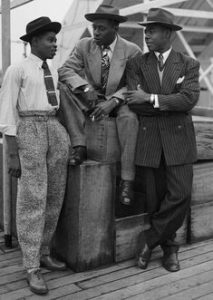
Born in the complex folds of postcolonial history, Afro dandyism draws inspiration from 19th-century European dandyism—with figures like Baudelaire or Oscar Wilde—as well as from African traditions where clothing has always played a central role in expressing identity, power, and spirituality. Yet it also radically departs from these influences. The Afro dandy does not seek to imitate the white elite, but rather to appropriate, divert, and transcend Western fashion codes to build a new visual language deeply rooted in Black and African experience.
One of the most iconic birthplaces of this movement is La SAPE—the Society of Ambiance-Makers and Elegant People—born in the Congo during the 1960s and ’70s. In Brazzaville and Kinshasa, men from economically marginalized neighborhoods invest in expensive branded clothing to present themselves with poise and confidence. La SAPE is an art of presence, of movement, of shining brightly in a world marked by poverty and violence. It transforms the street into a runway and the body into a work of art. But it is also a silent cry: “I am worthy. I am beautiful. I am visible.”
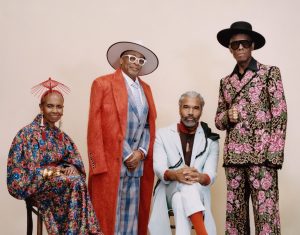
Afro dandyism is not confined to Central Africa. It has taken on new faces and spaces across the diaspora—in Paris, London, Johannesburg, Dakar, Abidjan, New York. Everywhere, young Afro-descendants, often in search of identity and visibility, reinvent the codes of fashion and style to celebrate their Africanness. They blend wax prints with English cuts, traditional fabrics with sneakers, turbans with designer glasses. They wear Afros or locs, proudly carry their heritage, and refuse to apologize for their existence.
The Afro dandy is a bridge between worlds. He juggles references, drawing as much from Malian textiles as from Italian suits, from ancestral symbols as from urban trends. He is both contemporary and timeless, rooted and globalized. In a world where fast fashion homogenizes bodies and tastes, he chooses distinction, slowness, and meaning. Each outfit tells a story, each color carries a message, each accessory is a nod to a world being reimagined.
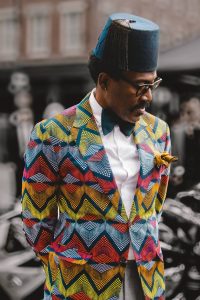
Artists like Omar Victor Diop, Hassan Hajjaj, and Kofi Ansah have highlighted Afro dandyism through photography, fashion, and visual arts. In their work, Black models are exalted—carriers of heritage and modernity, grace and power. They pose with pride, challenge Western gazes, and assert their own aesthetic, their own standards of beauty.
This movement does not belong solely to men. A new face of Afro dandyism is being carried by Afro-dandy women, who demand the same stylistic rigor and political consciousness. They elevate pagnes (wax cloths), wear androgynous cuts, and mix ethnic or futuristic jewelry. They bend gender norms and blur boundaries between masculine and feminine, tradition and innovation. Through their bodies and style, they loudly proclaim their freedom.
Afro dandyism is also deeply political, even when it appears frivolous. It opposes the often miserable or folkloric image of Africa portrayed in some Western media. It reasserts that Africa is not only a continent of conflict and poverty, but also one of creation, refinement, aesthetics, and thought. Clothing becomes an act of reclamation, a declaration of cultural sovereignty.
In a global society shaped by the legacies of slavery, colonialism, and racism, the Afro dandy reinvents elegance as a form of soft resistance. He turns style into a battleground—but also into a source of joy. For this is not only about opposition—it’s about celebration, creation, and radiance. To be an Afro dandy is to stand tall in one’s colors, to walk with poetry, to define erasure through beauty.
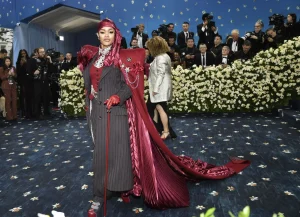 Today, in fashion shows, festivals, on social media and magazine covers, Afro dandyism emerges as a powerful affirmation of a plural, proud, refined Africa. It inspires a new generation of artists, designers, and thinkers who reject conformity and proudly carry both the memory and future of the continent.
The Afro dandy is not just a character. He is a movement. A vibration. A silent manifestation into the folds of a redesigned boubou or a reimagined suit. He reminds us that identity can be a work of art, that pride can be worn like a second skin, and that elegance can—indeed—be revolutionary.